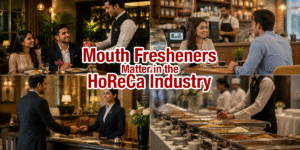


When a meal ends, there is often a small moment that comes after it. The plates are cleared, the bill is paid, and the customer gets ready to leave or collect their takeaway. In many Indian dining experiences, there has traditionally been one more part of the meal: a mouth freshener.
Saunf, mukhwas and other after-meal preparations have been part of Indian food culture for generations. They are familiar, easy to understand and naturally associated with the end of a meal.
What is changing is not the habit itself, but the way it is being presented.
As cafes, QSRs, restaurants and other food-service businesses adopt more convenient and packaged formats, mouth fresheners for HoReCa can fit into modern dining experiences in ways that are simple, practical and relevant.
An Old After-Meal Habit, in a New Format
Mouth fresheners are not a new concept in India. They have traditionally been served after meals at homes, family gatherings, weddings, traditional restaurants and other social occasions. Saunf and mukhwas have long been associated with the transition from the meal to the end of the dining experience.
Modern food-service formats are simply presenting this familiar habit differently. Instead of a shared container or loose serving, businesses can use individually packed mouth fresheners that are easier to store, serve and carry.
The product remains familiar, while the format becomes more suited to today’s dining habits.
This shift is important because convenience has become an increasingly relevant part of how food is served and consumed. For restaurants, cafes and QSRs, the ability to offer a product without adding complexity to the service process matters.
Why the After-Meal Moment Makes Sense for Mouth Fresheners
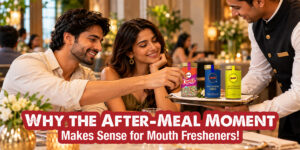
A mouth freshener has one advantage that many other complementary products do not: it naturally belongs to a specific moment.
Customers already understand why it is being offered.
After eating, an after-meal mouth freshener can provide a simple finishing touch to the meal. For the business, it can be introduced without changing the core service experience. For the customer, it is a familiar product being offered at a familiar time.
That relevance is what makes mouth fresheners interesting for HoReCa.
The idea is not to turn a mouth freshener into a major part of the dining experience. It is simply to recognise that the after-meal moment already exists.
From Saunf and Mukhwas to Individually Packed Mouth Fresheners
Traditional mukhwas was often served loose or from a common container. That format still exists in many places, but modern food-service environments have different operational requirements.
Cafes and QSRs need products that are easy to handle. Restaurants need convenient serving formats. Takeaway and delivery businesses need products that can travel with an order without creating unnecessary mess or additional handling.
This is where individually packed mouth fresheners can be useful.
A sealed sachet or pouch can be stored easily, handed over quickly and included with a takeaway or delivery order. It also provides a consistent serving format across different customers and locations.
The basic habit has not changed.
The way it reaches the consumer has.
Why Packaging Matters in HoReCa
In food service, even a small product has to work within the operational reality of the outlet.
A mouth freshener should ideally be easy to store, easy to serve and easy for the customer to use. Packaging therefore becomes more than just a design element.
For a busy QSR, an individually packed mouth freshener can be picked up and served without interrupting the regular service flow.
For a restaurant, it can be placed on the table, offered after the meal or handed over with the bill.
For takeaway and delivery orders, it can be added to the package without requiring any additional serving arrangement.
This makes packaging an important part of how packaged mouth fresheners can adapt to modern food-service formats.
Where Mouth Fresheners Can Fit
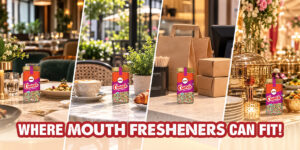
There is no single way for a HoReCa business to use a mouth freshener. Different formats can suit different occasions, service styles and customer expectations.
Mouth Fresheners for Dine-In Restaurants
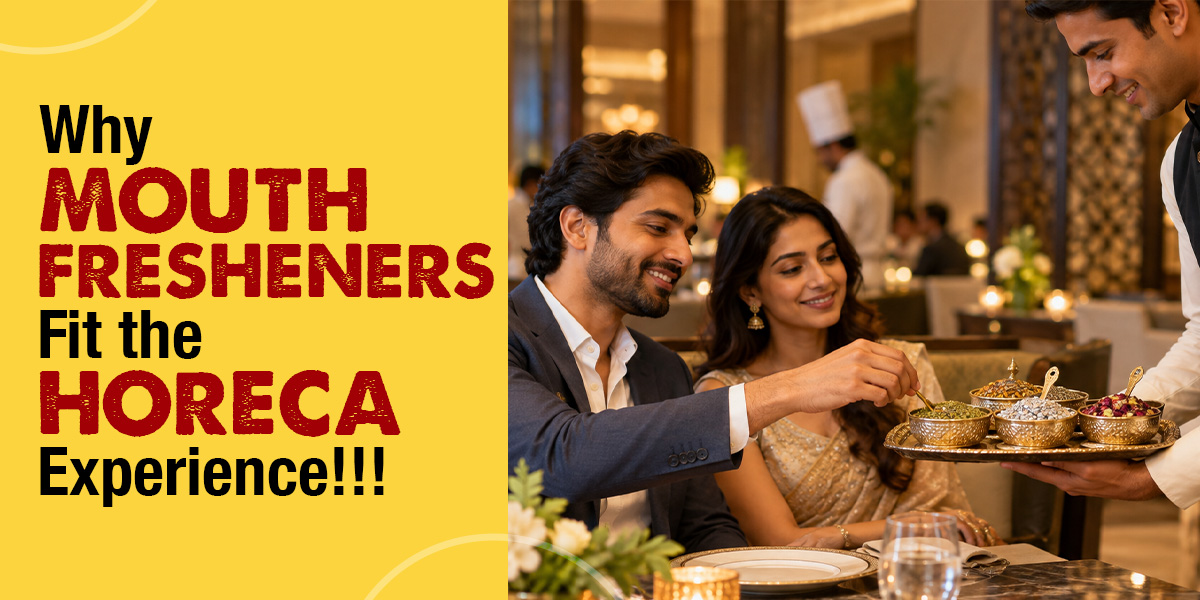
A mouth freshener for restaurants can be offered at the end of the meal, either along with the bill or as part of the final service interaction.
For Indian restaurants, especially those serving rich or traditional meals, the association can feel particularly natural. The product fits into an existing after-meal habit rather than introducing a completely new behaviour.
Mouth Fresheners for Cafes
Cafes have a different consumption occasion, but a mouth freshener for cafes can still work where the food and customer profile make it relevant.
The format may be simpler and more contemporary, particularly when the cafe is focused on quick service, convenience and takeaway consumption.
The important factor is not simply offering a mouth freshener, but ensuring that the product fits the overall customer experience.
Mouth Fresheners for QSRs, speed and ease of handling are particularly important.
A mouth freshener for QSRs can be included as part of the service or added to takeaway orders without requiring a separate serving process.
An individually packed format can make this easier because the product can be stored, picked up and handed over quickly.
The role remains small and specific, but that can also be its advantage.
Mouth Fresheners for Takeaway and Delivery
Takeaway and delivery provide another simple application.
A mouth freshener can travel with the order, giving the customer something relevant to use after finishing the meal.
Unlike a promotional leaflet or an unrelated freebie, the product has a direct connection to the occasion. It becomes part of the order experience without requiring additional explanation.
Mouth Fresheners for Events, Catering and Banquets
Mouth fresheners can also fit naturally into catering environments, where food is served to larger groups and a consistent, individually packed format can be practical.
For events, banquets and catered meals, the ability to offer the same format across multiple guests can make the product easier to manage.
Taste and Format Still Matter
Simply offering a mouth freshener does not automatically make it suitable for every food-service business.
Taste is important.
The flavour should work as an after-meal product and should be appropriate for the food and audience. A restaurant serving traditional Indian cuisine may have different requirements from a contemporary cafe or a quick-service outlet.
The format matters too.
A product that is difficult to open, inconvenient to store or unsuitable for the outlet’s service process is unlikely to become a useful addition.
This is why HoReCa businesses need to consider more than just the product itself. Taste, packaging, serving format, portion, storage and customer preference can all play a role.
A Mouth Freshener Can Also Become a Brand Touch point
There is another layer to the idea.
Food-service businesses spend considerable effort building their identity through menus, packaging, interiors, uniforms and digital communication. Small physical interactions can also contribute to how that identity is experienced.
A thoughtfully selected mouth freshener can become one of those small touchpoints.
For a restaurant chain, the same format can be used across outlets to create consistency.
For a cafe, the packaging can complement the overall visual identity.
For a takeaway brand, it can become part of the order experience.
However, the product should still feel like a mouth freshener first.
If the packaging becomes dominated by promotional messages, advertisements or sales communication, the natural relevance of the product can get lost. The customer should feel that it belongs to the meal, not that it was added simply as another marketing surface.
It Does Not Have to Be a Promotional Freebie
This distinction is worth making.
A mouth freshener does not necessarily need to be treated as a promotional giveaway.
Its value can simply come from being relevant to the occasion. A customer finishes a meal and receives something designed for that exact moment.
There is no complicated offer, no explanation and no additional action required.
That simplicity can be its strength.
In a food-service environment where businesses are constantly looking for ways to create smoother customer experiences, sometimes the most useful additions are the ones that require the least explanation.
The Opportunity Is Not the Same for Every Outlet
Not every cafe, QSR or restaurant needs to offer a mouth freshener.
The relevance depends on the type of food being served, customer profile, service style and overall positioning of the outlet.
An Indian family restaurant may find the traditional association particularly strong.
A QSR may prefer a compact, individually packed format.
A premium cafe may look for something that fits its packaging and presentation style.
A delivery-first food brand may see greater relevance in including it with selected orders.
There is no universal formula.
The product has to fit the occasion, the customer and the operating environment.
What Makes a Mouth Freshener Work in HoReCa?
The idea is simple, but a few factors can determine whether it works well.
Relevance: The mouth freshener should make sense after the type of food being served.
Taste: The flavour should be suitable for an after-meal occasion and appropriate for the intended audience.
Packaging: The packaging should be hygienic, convenient and easy to handle.
Serving: Staff should be able to offer it without disrupting the regular service flow.
Consistency: For chains and multi-outlet businesses, the same format should be easy to implement across locations.
Customer Fit: The product should match the expectations and preferences of the outlet’s audience.
Presentation: It should feel like a natural part of the experience rather than an unrelated promotional insert.
These factors may seem small individually, but together they determine whether a mouth freshener feels like a useful part of the meal or simply another item being handed to the customer.
From Traditional Mukhwas to a Modern Customer Touch point
The evolution of mouth fresheners reflects a broader change in how familiar Indian food habits are being adapted to modern consumption.
The traditional idea remains intact: something refreshing after a meal.
What has changed is the format.
Smaller packs, individual servings, convenient packaging and easier storage make mouth fresheners suitable for environments where speed, hygiene and consistency matter.
This makes them relevant not only to traditional restaurants but also to cafes, QSRs, takeaway businesses, catering services and other modern food-service formats.
The connection between the product and the occasion is what makes this transition possible.
A Small Product With a Clear Role
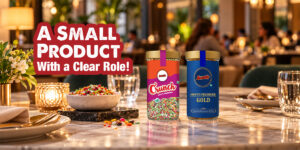
Mouth fresheners are not going to replace good food, efficient service or a well-designed dining experience.
They do not need to.
Their role is much smaller and more specific.
They belong to the moment after the meal.
For HoReCa businesses, that can make them a practical addition when the product, format and presentation are right.
For customers, they offer something familiar at a time when they already understand its purpose.
From traditional saunf and mukhwas to individually packed modern formats, the product has adapted without losing its basic place in Indian food culture.
And perhaps that is what makes the idea interesting.
A mouth freshener does not need to become a big part of the dining experience. It simply needs to fit naturally into the small moment when the meal is over.
Because sometimes, the last part of a meal deserves just as much thought as the first.